

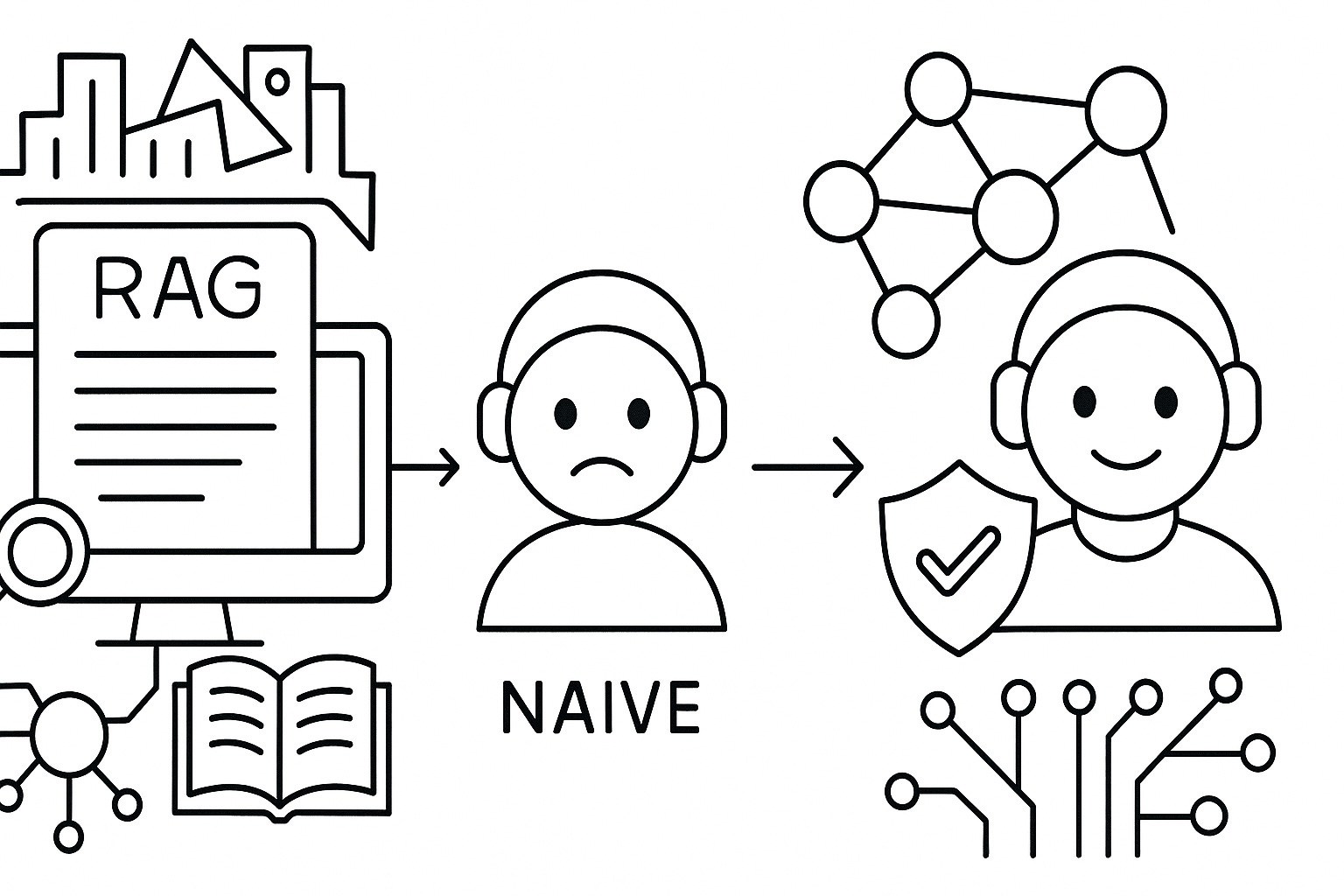
In the ever-evolving landscape of artificial intelligence, we’re witnessing a paradigm shift from simple prompt engineering to the more sophisticated discipline of context engineering. It’s no longer enough to craft the perfect query; the real challenge lies in furnishing Large Language Models (LLMs) with the right, verifiable information to generate trustworthy answers. This technical deep dive explores the evolution of Retrieval-Augmented Generation (RAG), examining the limitations of traditional approaches and charting a path forward with knowledge graphs, focusing on pioneering frameworks like Microsoft’s GraphRAG and its more agile counterpart, LightRAG.
Classic RAG: A Powerful, Yet Flawed, Solution
Retrieval-Augmented Generation (RAG) has become a standard technique for extending the capabilities of LLMs beyond their static training data, allowing them to access private or up-to-the-minute information. The process is relatively straightforward: when a user asks a question, the RAG system first retrieves relevant snippets of information from a knowledge base and then feeds these snippets, along with the original query, to an LLM to generate an answer.
How Traditional RAG Works:
Indexing: Documents are broken down into smaller pieces (chunks).
Embedding: Each chunk is converted into a numerical vector (embedding) that represents its semantic meaning.
Storing: These vectors are stored in a vector database.
Retrieval: The user’s query is also converted into a vector, and the database is searched for the most similar document chunk vectors.
Augmentation & Generation: The retrieved chunks are added to the context of the user’s prompt, and the LLM generates an answer based on this augmented information.
Despite its effectiveness in simple scenarios, this “naive” approach to RAG has significant drawbacks that become apparent as the complexity and scale of the knowledge base grow.
The Problems with Classic RAG:
Semantic Drift and Name Collisions: Vector search can retrieve semantically similar but contextually incorrect chunks. A query about “Project Alpha” might pull information about a client with the same name, leading to irrelevant results.
Context Leakage and Security Vulnerabilities: A poorly configured RAG can inadvertently include sensitive information, like personal data or financial details, in its response. Furthermore, bad actors can exploit techniques like “prompt injection” by embedding malicious instructions within source documents.
Lack of Relational Understanding: Naive RAG cannot grasp the complex relationships between pieces of information scattered across different documents. It fails to connect the dots between an employee going on vacation, their temporary replacement, and a project they were managing.
Contradictory Information: If the retrieved chunks contain conflicting information, the LLM can become confused, leading to hallucinations or inaccurate answers.
Enter Knowledge Graphs: Bringing Structure to Context
To overcome these limitations, the industry is turning to knowledge graphs. A knowledge graph is essentially a structured representation of information, where entities (people, projects, documents) are nodes, and the relationships between them are edges. Instead of treating information as isolated text snippets, knowledge graphs capture the intricate web of connections, enabling a deeper, more contextual understanding.
Advantages of Knowledge Graphs in RAG:
Improved Accuracy and Relevance: By querying the graph, a system can retrieve not just individual entities but also their related entities and relationships, providing a more comprehensive and relevant context for the LLM.
Verifiability and Explainability: Answers generated using knowledge graphs can be traced back to the source entities and relationships in the graph, allowing users to verify the source of the information and understand how the system arrived at its conclusion.
Reduced Hallucinations: By feeding the LLM structured and validated information, knowledge graphs significantly reduce the likelihood of the model “making up” facts.
Microsoft’s GraphRAG: A Powerful but Costly Pioneer
One of the first major attempts to merge knowledge graphs with RAG is Microsoft’s GraphRAG framework. This comprehensive pipeline uses an LLM to automatically extract entities and relationships from unstructured text to build a knowledge graph.It then uses hierarchical clustering to group related entities into “communities” and generates summaries for each cluster at various levels of abstraction.
How GraphRAG Works:
Indexing: An LLM analyzes source documents to extract entities and relationships, creating a knowledge graph.
Clustering: Community detection algorithms group closely related entities.
Summarization: The LLM generates descriptive summaries for each community.
Retrieval: When a query is made, the system searches for relevant communities via their summaries and then drills down into the graph for detailed context.
Generation: The LLM uses the retrieved information to generate a comprehensive answer.
While incredibly powerful and capable of answering complex, multi-hop questions, GraphRAG has a significant drawback: high cost. The indexing process, particularly the summarization of clusters, requires a massive number of API calls to powerful LLMs, making it computationally expensive and resource-intensive.
LightRAG: The Agile and Cost-Effective Alternative
In response to the complexity and cost of GraphRAG, researchers at the University of Hong Kong developed LightRAG, a lightweight framework that retains the benefits of the graph-based approach while dramatically reducing the computational overhead.
LightRAG simplifies the architecture by jettisoning the multi-level hierarchical clustering and summarization in favor of an elegant, dual-level retrieval system.
The LightRAG Architecture:
Keyword Extraction: When a query is received, an LLM extracts two types of keywords:
Local Keys: Specific entities mentioned in the query (e.g., “employee Petrov”).
Global Keys: Broader concepts and themes (e.g., “financial optimization”).
Parallel Search:
Local keys are used to search for specific nodes in the knowledge graph.
Global keys are used to search for broader, conceptual relationships.
Context Expansion: Instead of just returning the retrieved entities, LightRAG queries their “neighborhood” within the graph, pulling all their immediate neighbors and connections. This creates a compact yet highly meaning-dense subgraph that serves as the context.
Incremental Updates: Unlike GraphRAG, which requires a full graph rebuild when new data is added, LightRAG supports incremental updates, making it far more efficient for dynamic knowledge bases.
This approach drastically cuts down on the required API calls, making LightRAG hundreds of times cheaper than GraphRAG while, on some metrics, delivering even better answer quality.
Practical Considerations and Future Directions
The move to graph-based RAG systems is not a silver bullet. The success of any of these systems is heavily dependent on the quality of the input data. Organizations must invest in standardizing terminology, defining clear relationships, and establishing naming conventions for entities.
Key Takeaways:
Naive RAG: Fast and cheap, ideal for simple Q&A bots and document search, but falls short on complex queries.
Microsoft GraphRAG: Extremely powerful for deep analysis of complex datasets, but its cost and complexity make it overkill for most applications.
LightRAG: Offers a balanced approach, combining the power of knowledge graphs with efficiency and cost-effectiveness, making it a promising solution for a wide range of tasks.
As we move toward more sophisticated and autonomous AI agents, the need for reliable, verifiable, and context-aware systems will only grow. Graph-based RAG frameworks like LightRAG represent a significant step forward in building AI assistants we can trust with real-world business challenges, paving the way for a future where AI-generated answers are not just eloquent, but provably true.